

When you install cable protection outdoors, UV resistant heat shrink tubing must withstand more than the heat used during installation. Direct sunlight exposes the polymer to ultraviolet radiation that can gradually change its surface and physical properties. Rain, humidity, temperature cycling, condensation, dirt, and mechanical movement add further stress. If you choose tubing based only on diameter and shrink ratio, you can end up with a product that installs correctly but does not provide the service life your outdoor application requires.
For long-term outdoor use, you need to evaluate UV resistance together with weather exposure, material, temperature range, moisture protection, mechanical conditions, and the required shrink ratio.
Who This Guide Is For
Electrical Contractors and Project Buyers
If you’re an electrical contractor or project buyer, you need tubing that remains suitable after installation rather than simply shrinking correctly on day one. Outdoor cable runs can experience years of sunlight, rain, heat, cooling, and physical movement, so your specification needs to account for the actual installation environment. DIFVAN gives you heat shrink tubing options that can be matched to cable dimensions and application requirements.
• Consistent specifications for repeat project orders
• Options for outdoor cable protection requirements
Importers and Distributors
If you’re an importer or distributor, you need an outdoor heat shrink tubing range that covers common cable protection requirements without creating unnecessary product complexity. Your customers may need different shrink ratios, diameters, wall thicknesses, or adhesive-lined constructions depending on the application. DIFVAN supports different tubing specifications so you can build a more practical product range around real customer requirements.
• Multiple sizes and shrink ratios
• Bulk and OEM supply support
Retailers and DIY Chains
If you’re a retailer or DIY chain, your customers need tubing that matches their cable size and intended environment without requiring complex engineering knowledge. Outdoor users may need stronger environmental protection than customers working inside dry electrical enclosures. DIFVAN can help you source tubing across common sizes and constructions so your product range addresses both general and outdoor cable protection needs.
• Clear size-based product selection
• Outdoor application options
Brands and OEM Manufacturers
If you’re a brand or OEM manufacturer, you need consistent tubing dimensions and material specifications across production batches. Your application may also require a defined shrink ratio, wall thickness, temperature range, or adhesive lining for environmental protection. DIFVAN supports OEM requirements where repeatability and controlled product specifications matter to your finished product.
• Consistent production specifications
• OEM and custom sourcing support
Use the table below to identify the tubing construction you should evaluate first for your application.
| Application Scenario | Recommended Specification |
|---|---|
| Direct sunlight exposure | UV-resistant outdoor-grade heat shrink tubing |
| Outdoor cable connection | UV-resistant tubing matched to cable diameter |
| Rain and condensation exposure | Adhesive-lined outdoor heat shrink tubing where sealing is required |
| Outdoor equipment wiring | UV-resistant polyolefin tubing matched to operating conditions |
| Cable transition exposed to weather | Higher shrink-ratio tubing when the diameter change requires greater recovery range |
Your environment determines the specification. The cable diameter alone does not.
How UV Exposure Affects Heat Shrink Tubing Over Time
When you expose heat shrink tubing to direct sunlight, ultraviolet radiation interacts with the polymer structure at the exposed surface. The exact degradation mechanism depends on the material formulation, stabilizers, exposure intensity, temperature, and duration. Over extended service, unsuitable tubing can experience changes such as surface chalking, discoloration, loss of flexibility, cracking, or reduced mechanical performance.
You should therefore treat UV exposure as a material-selection requirement rather than assuming that every black heat shrink tube is suitable for outdoor installation.
Color alone does not establish UV resistance.
A tubing product may look identical to another product during installation while having a different formulation for long-term outdoor exposure. UV stabilizers and the underlying polymer system influence how the material responds to solar radiation. For a project where the tubing remains continuously exposed, you should request the manufacturer’s documented outdoor or weathering suitability rather than selecting a product based only on appearance.
This matters most on exposed cable runs where you cannot easily replace the tubing after installation.
Weathering Factors That Affect Outdoor Cable Protection
UV radiation is only one part of the outdoor environment. Your tubing can also experience repeated heating and cooling as the cable surface warms under sunlight and cools at night. These temperature cycles can cause dimensional movement in the cable assembly and place repeated mechanical stress on the recovered tubing, particularly when the protected connection is rigid or exposed to vibration.
Outdoor service is a combination of environmental stresses, not a single exposure.
Moisture creates another selection consideration. Rainwater, condensation, and high humidity can reach cable connections through openings, damaged insulation, or poorly protected transitions. Standard heat shrink tubing can provide insulation and mechanical protection, but you should consider adhesive-lined construction when your application requires an environmental seal around the connection.
Do not confuse electrical insulation with complete moisture sealing.
Dirt and airborne contaminants also matter over long service periods. Deposits can retain moisture against the cable surface and increase the severity of the local environment. If your installation sits near roads, industrial equipment, agricultural areas, coastal environments, or other contamination sources, you should evaluate the tubing construction against the actual exposure rather than treating the location as simply “outdoor.”
Your outdoor specification should reflect the site, not just the installation label.
Material Selection for Long-Term Outdoor Exposure
Cross-linked polyolefin is a common material choice for heat shrink tubing because it can provide electrical insulation, mechanical protection, flexibility, and controlled recovery when correctly specified. For outdoor applications, however, you should evaluate the exact formulation and product specification rather than assuming that every polyolefin product has identical weathering performance.
The polymer family is only the starting point.
When moisture sealing becomes important, adhesive-lined heat shrink tubing provides another layer of protection. As the tubing recovers, the internal adhesive can flow around the underlying cable or connection and help seal the interface when the product is designed for that application. You still need to confirm the tubing’s recovery range, adhesive characteristics, operating temperature, and compatibility with the cable jacket.
Choose adhesive lining when the connection requires environmental sealing, not simply because the installation is outdoors.
Matching Tubing Construction to Outdoor Conditions
Your selection should become more specific as environmental exposure becomes more severe. A cable installed beneath a protected enclosure does not face the same conditions as a cable mounted directly on outdoor equipment. Likewise, a sheltered industrial installation has different requirements from a cable connection exposed to continuous tropical sunlight and rainfall.
The same tubing specification should not automatically be applied to every outdoor location.
For general outdoor cable protection, you should verify UV suitability, dimensional recovery, wall thickness, operating temperature, and material construction. Where water ingress is a concern, evaluate adhesive-lined tubing. Where the cable experiences substantial movement or vibration, consider whether the tubing’s flexibility and recovered mechanical properties are suitable for the application.
The correct product is the one that matches the complete exposure profile.

Choosing the Right Shrink Ratio for Outdoor Applications
Your shrink ratio determines how much dimensional variation the tubing can accommodate during installation. A 2:1 product can recover to approximately half of its supplied diameter, while 3:1 and 4:1 products provide progressively greater recovery capability. You should compare the tubing’s expanded diameter with the largest section it must pass over, then check the recovered diameter against the smallest section that needs to be covered.
The correct shrink ratio depends on your connection geometry.
If your outdoor connection has a relatively uniform diameter, 2:1 tubing may provide enough recovery. If you are covering a connector, splice, terminal, or transition with significantly different diameters, a higher shrink ratio can make installation easier and produce more consistent coverage. You should still check the manufacturer’s actual supplied and recovered dimensions because nominal shrink ratios do not describe every dimensional detail.
Higher shrink ratio does not automatically mean better outdoor performance.
Sizing UV Resistant Heat Shrink Tubing Correctly
Before you order UV resistant heat shrink tubing, measure the largest diameter that the tubing must slide over. Then identify the smallest diameter that the recovered tubing must grip. This gives you the two dimensions that control the basic size decision. You should also account for connectors, crimped terminals, cable joints, and other features that increase the installation diameter.
Measure the complete assembly, not only the cable jacket.
Your selected tubing should be large enough to pass over the connection without excessive force and small enough to recover securely around the protected area. If you choose tubing that is too large, it may not recover tightly enough. If you choose tubing that is too small, you can struggle to position it correctly or damage the tubing during installation.
Correct sizing supports both sealing and mechanical protection.

Preparing an Outdoor Cable Before Shrinking
Your installation surface needs to be clean, dry, and free from contaminants before you apply heat. Dirt, oil, moisture, and residue can interfere with adhesion when you use adhesive-lined tubing and can also affect the finished appearance of standard tubing. If the cable has damaged insulation or an unsuitable surface condition, you should correct that problem before covering the area.
Good preparation starts before the heat gun is switched on.
Position the tubing carefully so the finished recovery covers the complete target area. Leave enough overlap beyond the connection where the product instructions require it. You should also confirm that nearby cable insulation and components can tolerate the heating process before applying heat.
Positioning errors become difficult to correct after recovery.
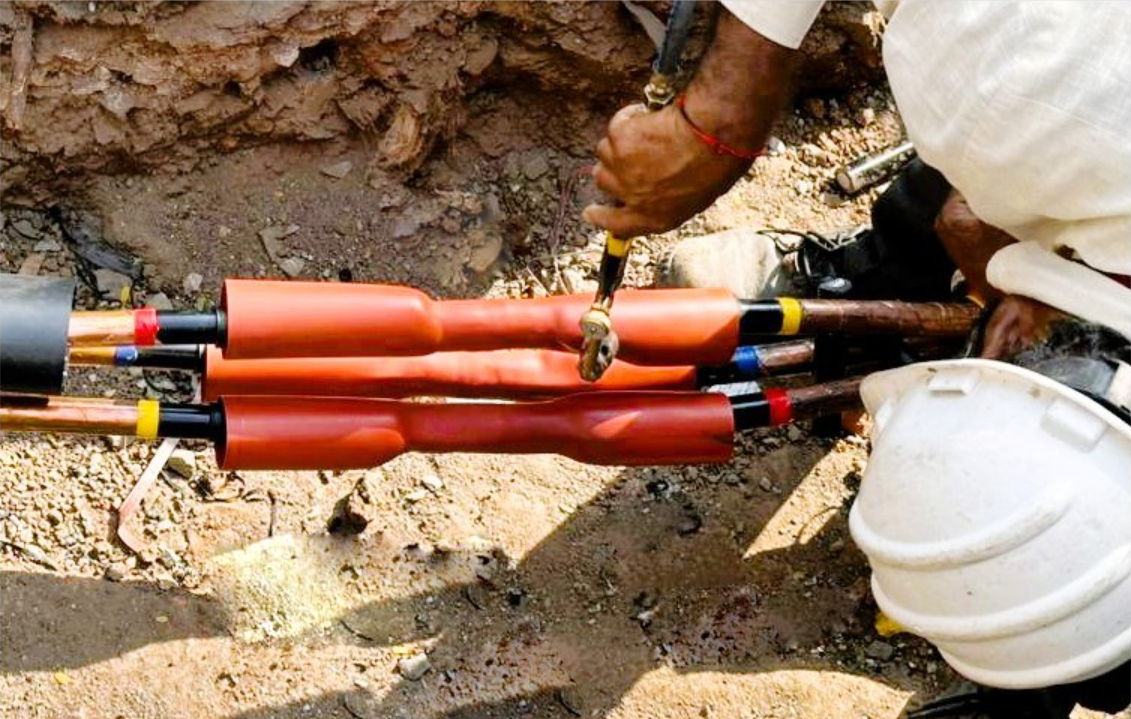
Applying Heat Without Damaging the Tubing
When you heat outdoor heat shrink tubing, apply heat progressively rather than concentrating the heat in one location. Move the heat source around the tubing so recovery occurs evenly around the circumference. Excessive localized heating can damage the polymer or the underlying cable jacket, while insufficient heat can leave sections incompletely recovered.
Controlled heating produces a more consistent finished installation.
You should follow the temperature and installation instructions supplied for the specific tubing. A heat gun designed for heat shrink applications gives you better control than improvised heating methods. DIFVAN’s heat gun guidance also emphasizes controlled heating and continuous movement around the tubing during recovery.
Your objective is uniform recovery, not maximum heat.

What Changes When You Install Tubing in Direct Sunlight?
Direct sunlight can make the cable and tubing substantially hotter than the surrounding air. Dark cable jackets and outdoor equipment surfaces can absorb solar radiation and raise the local temperature. If your installation also experiences high ambient temperatures, you should compare the expected operating condition with the tubing’s specified service temperature rather than relying on normal room-temperature performance.
Your operating temperature must include the outdoor environment.
Temperature cycling also creates repeated expansion and contraction. Over time, these cycles can interact with vibration, cable movement, and differences between the tubing and cable materials. Where the cable moves frequently, you should consider whether the selected tubing remains flexible enough for the application after recovery.
Long-term outdoor performance depends on temperature as well as UV exposure.
When Standard Tubing Is Not Enough
Standard heat shrink tubing may provide adequate protection for sheltered outdoor wiring, but you should move to a more specialized construction when the environment adds significant moisture, movement, chemicals, or mechanical stress. Adhesive-lined tubing becomes particularly relevant when you need the recovered assembly to resist moisture entering around the cable interface.
You should upgrade the construction when the environment requires it.
For exposed industrial equipment, you should also consider contact with oils, fuels, cleaning agents, solvents, or other chemicals. Chemical compatibility depends on the exact tubing formulation and exposure conditions. If your installation faces repeated chemical contact, request product-specific compatibility information before approving the material.
Outdoor suitability does not automatically mean chemical compatibility.
Comparing Outdoor Tubing Options
When you have several tubing constructions available, compare them according to the actual failure risks in your application. A general-purpose polyolefin tube may be suitable for exposed cable insulation, while adhesive-lined tubing can provide additional environmental protection around a connection. Specialized materials may become necessary when you face unusual temperature, flexibility, or chemical requirements.
Use the comparison below as a selection tool, not as a replacement for the product datasheet.
| Material or Construction | Best Fit | Key Selection Consideration |
|---|---|---|
| Cross-linked polyolefin | General outdoor cable protection | Verify UV and weathering suitability |
| UV-stabilized polyolefin | Prolonged sunlight exposure | Confirm documented outdoor performance |
| Adhesive-lined polyolefin | Outdoor connections exposed to moisture | Verify adhesive compatibility and recovery range |
| Specialized elastomeric tubing | Flexible outdoor assemblies | Check temperature, flexibility, and environmental limits |
| PVC-based tubing | Less demanding protected applications | Confirm suitability for continuous outdoor exposure |
If your cable remains directly exposed to sunlight, prioritize documented UV performance. If moisture can reach the connection, evaluate adhesive-lined construction as part of the specification.
Common Outdoor Failure Modes and How to Prevent Them
UV degradation is one possible failure mode when you use tubing without adequate outdoor resistance. You may see discoloration, surface changes, cracking, or loss of flexibility after prolonged exposure, depending on the material and conditions. The prevention strategy starts with selecting a product specifically intended for the expected exposure and confirming the manufacturer’s environmental information.
Do not use appearance as your only indicator of UV resistance.
Incomplete recovery creates another problem. If the tubing does not recover sufficiently around the cable or connection, the finished assembly may have poor mechanical contact and an inconsistent seal. This can result from incorrect sizing, insufficient heating, or selecting a shrink ratio that cannot accommodate the connection geometry.
Check both sizing and recovery during installation.
Moisture ingress can occur when the application requires sealing but the selected tubing only provides insulation and physical coverage. Water can enter around transitions or interfaces and remain trapped against the cable. Where environmental sealing is required, select an appropriate adhesive-lined construction and follow the manufacturer’s installation procedure.
A weatherproof application requires more than a weather-resistant material.
Outdoor Application Decision Guide
Your final selection should start with the exposure conditions and then move toward the product specification. If the tubing receives continuous sunlight, verify UV suitability. Rain or condensation can reach the connection, determine whether adhesive lining is required. If the assembly moves or vibrates, check flexibility and mechanical performance. If the site experiences extreme temperatures or chemicals, verify the applicable limits before purchasing.
The environment should drive the specification.
For routine outdoor cable protection, a suitable UV-resistant polyolefin construction may provide the required combination of insulation and mechanical protection. Exposed connections where moisture is a major concern, adhesive-lined tubing can provide additional protection. For specialized industrial environments, you should request the complete technical datasheet and confirm compatibility with the cable and operating conditions.
Select the simplest construction that fully meets your actual requirements.
Technical Specification Reference
Use the following reference when you prepare your purchase specification. You should confirm the exact values against the selected DIFVAN product because dimensions, temperature ratings, wall thickness, and environmental performance vary between constructions.
| Specification | What You Need to Confirm | Why It Matters |
|---|---|---|
| Material | Exact polymer construction | Determines mechanical and environmental behavior |
| UV resistance | Documented outdoor or UV suitability | Determines suitability for prolonged sunlight |
| Shrink ratio | 2:1, 3:1, 4:1, or specified ratio | Determines recovery capability |
| Supplied diameter | Minimum and maximum supplied dimensions | Determines whether tubing fits over the connection |
| Recovered diameter | Final recovered dimension | Determines grip around the protected area |
| Wall thickness | Supplied and recovered wall thickness | Affects insulation and mechanical protection |
| Operating temperature | Minimum and maximum service temperature | Determines suitability for the outdoor environment |
| Adhesive lining | Required or not required | Determines whether adhesive-based sealing is available |
| Color | Product-specific | Can affect identification and application requirements |
Use these values when writing your purchase specification so your supplier can match the product to the actual installation.

DIFVAN has more than 20 years of manufacturing experience producing cable management products, heat shrink tubing, and electrical connection components. That production experience matters when you need repeat orders to maintain consistent dimensions and material specifications across a long project. Receiving a different tubing specification halfway through an installation can create unnecessary rework and procurement delays.
DIFVAN provides multiple heat shrink tubing constructions, diameters, and shrink ratios for different cable protection requirements. That gives you flexibility when your project includes standard cable insulation, outdoor connections, different cable diameters, or applications requiring adhesive-lined protection.
DIFVAN also supports bulk supply, OEM requirements, and international export orders. You can use consistent product specifications across project phases instead of sourcing different products when your volume or application requirements change.
You can contact the DIFVAN technical and commercial team for project-specific requirements and quotation support. When you are finalizing a bill of materials, direct access to product information helps you resolve sizing, material, and application questions before placing an order.
Working with DIFVAN gives you a direct manufacturer relationship for repeat sourcing and specification control. You can standardize your heat shrink tubing requirements while maintaining access to technical and commercial support as your projects develop.


FAQs
What is UV resistant heat shrink tubing?
UV resistant heat shrink tubing is designed for applications where the tubing remains exposed to ultraviolet radiation from sunlight. You should select a product with documented suitability for prolonged outdoor exposure rather than assuming that standard heat shrink tubing will perform the same way. The material formulation, UV stabilizers, and product construction influence long-term resistance. Your final selection should match the expected exposure period and operating environment.
Can you use regular heat shrink tubing outdoors?
You should not assume that standard heat shrink tubing is suitable for continuous outdoor exposure. Direct sunlight, temperature cycling, rain, humidity, and contamination can create stresses that indoor tubing may not be designed to handle. If your installation remains exposed, verify the manufacturer’s outdoor suitability. This is especially important when replacement would require shutting down equipment or accessing difficult cable runs.
What makes heat shrink tubing UV resistant?
UV resistance comes from the tubing’s material formulation and its ability to withstand prolonged ultraviolet exposure without unacceptable degradation. Stabilizers and polymer selection can influence how the material responds to sunlight over time. You should rely on manufacturer documentation rather than tubing color alone. Black tubing is not automatically UV resistant.
Is black heat shrink tubing suitable for outdoor use?
Black color alone does not prove outdoor suitability. You should check whether the specific tubing formulation is designed and specified for prolonged UV exposure. Two black products can have different polymer formulations and different weathering performance. For a permanent outdoor installation, use the manufacturer’s environmental specification as your selection reference.
What type of heat shrink tubing is best for outdoor cables?
Cross-linked polyolefin is a common choice for outdoor cable protection when the product is specifically suitable for the expected environment. If your connection also needs protection against moisture ingress, adhesive-lined construction may be more appropriate. You should compare UV resistance, temperature range, shrink ratio, wall thickness, and environmental sealing requirements before choosing.
Does UV resistant heat shrink tubing make a connection waterproof?
UV resistance and waterproofing describe different performance requirements. UV resistance addresses exposure to ultraviolet radiation, while moisture protection depends on the tubing construction, installation, and connection geometry. If you need an environmental seal, evaluate adhesive-lined tubing designed for that purpose. You should also avoid treating the tubing itself as proof that the complete electrical assembly has a particular IP rating.
How long does UV resistant heat shrink tubing last outdoors?
There is no single service-life value that applies to every outdoor heat shrink product. Actual service life depends on UV intensity, temperature, weather exposure, material formulation, installation quality, and mechanical conditions. You should use the manufacturer’s stated environmental performance and testing information when service-life requirements are important. Continuous tropical sunlight can impose different demands from sheltered outdoor exposure.
What shrink ratio should you use for outdoor heat shrink tubing?
Your shrink ratio should match the diameter variation of the connection you need to cover. A 2:1 product can work well where the starting and final diameters are relatively close, while 3:1 or 4:1 tubing gives you more recovery range. You should always compare the actual supplied and recovered dimensions before ordering. The outdoor environment does not determine the shrink ratio by itself.
How do you install UV resistant heat shrink tubing?
You should first select the correct size and position the tubing over a clean, dry connection. Apply controlled heat progressively around the tubing instead of holding the heat source in one place. Continue until the tubing has recovered evenly according to the manufacturer’s instructions. Allow the assembly to cool without moving it unnecessarily.
How do you choose heat shrink tubing for long-term outdoor use?
Start by identifying the actual environmental exposure, including direct sunlight, rain, condensation, temperature cycling, vibration, chemicals, and mechanical movement. Then specify the material, UV suitability, supplied diameter, recovered diameter, shrink ratio, wall thickness, temperature range, and adhesive construction where required. You should confirm the complete specification against the manufacturer’s datasheet before ordering. This approach gives you a tubing specification based on service conditions rather than cable size alone.

If your cable protection will remain exposed to sunlight and weather, choose UV resistant heat shrink tubing according to the complete environmental profile. Verify UV suitability first, then evaluate moisture, temperature, mechanical stress, chemical exposure, shrink ratio, and recovered dimensions.
Do not treat outdoor heat shrink tubing as a generic product category. Match the construction to the actual conditions your cable will face throughout its service life.
DIFVAN supplies heat shrink tubing engineered for demanding B2B environments. Whether you need bulk supply, OEM support, or help selecting the right specification for your project, contact the DIFVAN team for a quote.

